A product analyst is the person on a product team who turns user behavior data into decisions: they measure how people actually use the product, explain why the numbers moved, and tell the team what to change next.
If you are choosing a certification to move that career forward, the practical stack is a foundation credential such as Google's Data Analytics Professional Certificate, one tool credential such as Microsoft's PL-300, and one product analytics or experimentation credential once you are working with real product data.
I wrote this for working product analysts deciding what to learn next and for people moving into the role from different positions. It covers what the job actually involves, how it differs from the roles around it, what it pays, which certifications are worth the money, and how the career path runs from a first analyst job to leadership.
Key Takeaways
A product analyst focuses on in-product user behavior, while a data analyst supports many departments and a data scientist builds predictive models.
Reported product analyst pay in the US varies by source and by what is being measured: Built In puts the average base at $79,954 with $7,875 in additional cash, while Glassdoor's median total pay in the top-paying industries runs from about $98,900 to $103,100.
No certification is required to work as a product analyst. The one worth taking is the one that fills a specific gap in your stack.
Google's Data Analytics Professional Certificate is nine courses on Coursera at $49 a month, about six months at 10 hours a week, and carries an ACE recommendation of up to 12 college credits.
Microsoft's PL-300 is a proctored exam with a 700 out of 1000 pass mark, listed at $165 in the US, renewed each year at no cost through an online assessment on Microsoft Learn.
INFORMS restructured its analytics certification in 2025: aCAP was retired and replaced by CAP-Essentials and CAP-Pro, with CAP-Expert as the senior tier accredited by ANAB under ISO/IEC 17024.
Product School's Product Analytics & Experimentation Certification runs live over three weeks with 12 live hours and a graded final project, and it expects existing product experience rather than serving as an entry point.
A portfolio of three real analyses beats a certificate in most interviews, so favor programs that leave you with work you can show.
What Is a Product Analyst?
A product analyst helps a product team make decisions using data about how people use the product. They measure behavior, explain what changed, and recommend what the team should do about it.
Imagine you are running a food delivery app. One feature lets users reorder a favorite meal in a single tap. It launched a month ago, and the team wants to know whether it worked. The product analyst is the person who answers that. It might be that the feature is popular with new users and ignored by returning ones, or that it lifts orders in cities and does nothing in the suburbs.
At their core, product analysts answer three questions:
What are users doing inside the product?
Why are they behaving that way?
What should we change or double down on as a result?
Analysts usually sit with a product squad and report to product, analytics or data, depending on company size. In product-led organizations, that seat matters because the gap between what a team thinks is happening and what is actually happening is where most wasted roadmap effort lives.
What Does a Product Analyst Do?
The work spans the whole product development process, and it looks different in a ten-person startup than in an enterprise analytics team. These responsibilities show up almost everywhere:
Uncover behavior patterns: track how users move through the product and identify which features drive engagement and which are ignored.
Investigate friction: find where users drop off in product onboarding, in a key workflow or after a release, and quantify the cost.
Shape decisions with evidence: support or challenge assumptions from product discovery through to sunsetting a feature.
Run and interpret experiments: design tests, protect statistical rigor, and read results in terms of business impact. A/B testing is the starting point of that toolkit.
Define the metrics: work with product managers on product adoption metrics and OKRs so the team measures product health rather than activity.
Own instrumentation: set up event tracking and clean up taxonomy, so the numbers can be trusted in the first place.
Support launches: monitor product adoption before, during, and after release, and flag early signals.
Find growth and monetization opportunities: spot the segments where a feature is quietly working.
Build self-serve reporting: dashboards, recurring reports and alerts, so decisions stop queuing behind an analyst's inbox, and help PMs, designers and executives read the results correctly.
The concrete output is what matters. A good quarter produces artifacts other people use: a tracking plan engineering implements, a funnel teardown that reprioritizes onboarding, a retention cohort read that kills a feature, and an experiment readout the team acts on.
Product analyst skills
The skill list is long, but it clusters into four groups.
Data and query: SQL for product databases and event logs, spreadsheets, enough data modeling and ETL familiarity to know where numbers come from, and basic Python or R.
Product analytics and experimentation: analytics platforms such as Mixpanel, Amplitude, Looker, or Tableau, event instrumentation in tools like Segment, experimental design, statistical significance, and cohort and funnel analysis.
Product craft: metric logic such as the North Star Metric, HEART, or AARRR, plus working inside agile delivery with PMs, product designers, and engineers.
Communication and judgment: turning a vague product question into a structured product analysis, presenting to technical and non-technical audiences, and balancing speed against rigor when the data is imperfect.
The fourth cluster is the one that separates people. Abhinav Kasliwal, AI Product and Technology Leader at Amazon, made the point in a Product School webinar about AI products, and it generalizes: "Accuracy measures model performance, not product success."
A technically correct analysis that nobody acts on has the same business value as no analysis at all.
Product Analyst vs Other Roles
The title overlaps with several others, and the boundaries move by company size. Here is the shape of each role:
Role | Primary focus | Typical output | Where it overlaps with a product analyst |
Product analyst | In-product user behavior | Funnel and retention analyses, experiment readouts, tracking plans | — |
Product manager | What to build and why | Strategy, roadmap, prioritization decisions | Both own product outcomes; the PM decides, the analyst supplies the evidence |
Data analyst | Business questions across departments | Reports and dashboards for marketing, finance, and operations | Same techniques, wider scope, less product context |
Business analyst | Requirements and internal process | Requirements documents, process maps, system specifications | Both analyze, but the business analyst looks inward at systems |
Data product manager | Data platforms treated as products | Pipelines, internal data tools, platform roadmaps | The data PM makes data usable; the analyst uses it |
Growth analyst | Acquisition and conversion funnels | Channel, campaign, and landing-page analyses | Both run experiments; the growth analyst starts earlier in the funnel |
UX researcher | Why users behave as they do | Interviews, usability studies, qualitative synthesis | Complementary: quantitative what, qualitative why |
Data scientist | Prediction and modeling | Models, recommendation, and forecasting systems | Both use statistics; the scientist builds models, and the analyst drives decisions |
Two of these deserve more than a table cell.
Against a data analyst, the difference is depth. A data analyst might report on campaign performance in the morning and support-ticket volumes in the afternoon. A product analyst lives inside one product area and carries the context that makes a number meaningful, which is also why they catch things a generalist misses.
Against a data scientist, the difference is the decision horizon. Data scientists build models that predict. Product analysts explain what just happened and what to do about it this sprint. In mature teams, the division is clean: the scientist builds the model, the analyst turns its output into a product decision. For the adjacent data role, see our guide to the data product manager.
How a Product Analyst Job Changes by Company and Context
The title stays the same while the job changes completely. Four variables explain most of the variation.
Company size and stage
In startups, product analysts are generalists. They set up tracking, own dashboards, and analyze churn and marketing funnels, often as the only source of insight in the building. In scaleups, the role specializes in user onboarding, retention, or monetization. In enterprises, analysts sit in a central insights team, working across a portfolio and standardizing metric definitions.
Product lifecycle stage
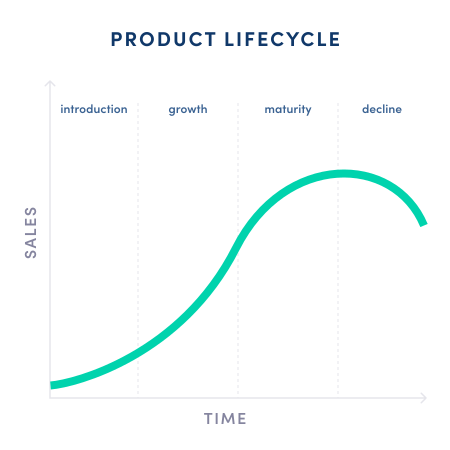
During discovery and MVP work, the job is to size opportunities and find early demand signals. Post-launch, it is monitoring adoption. In mature products, it shifts to optimization, segmentation, and churn modeling.
Ways of working
In agile teams, analysts sit in sprint planning and retros and support continuous discovery with near real-time data. In experiment-led cultures, they own the testing infrastructure and the standards that keep results trustworthy.
Team maturity and tooling
In high-maturity teams, analysts spend less time on reporting and more on causal inference. In fast-growing teams, they are still writing tracking plans and teaching people how to read a funnel. One expectation now cuts across all of them: analysts use AI tools for query drafting and first-pass synthesis, which has made the first pass faster without lowering the bar for the conclusion.
For a deeper look at the discipline itself, our guide to product analytics covers the methods, and the Product School webinar with Enzo Avigo, formerly a product manager at Intercom, is worth watching here.
How Much Does a Product Analyst Make?
Reported product analyst pay in the US clusters between roughly $80,000 and $103,000, depending on the source and on whether the figure is base salary or total compensation.
Built In reports a US average base salary of $79,954, with $7,875 in additional cash compensation, for an average total of $87,829.
Glassdoor reports median total pay by industry, with the top five running from about $98,866 in pharmaceutical and biotechnology to $103,058 in information technology.
For a wider reference point on the entry into analytics generally, Coursera cites Lightcast data, putting the median entry-level data analytics salary at $97,000.
Those numbers disagree for three ordinary reasons, and it is worth knowing them before you negotiate. Self-reported samples are skewed by who bothers to submit. Base salary and total compensation are compared as if they were the same thing. And titles inflate unevenly, so a "product analyst" at one company is doing the work of a "senior analytics manager" at another.
Lastly, location moves the number more than any certificate will. The same role in San Jose or New York pays materially more than the national average.
What Certifications Can Help You Advance as a Product Analyst?
No certification is required to work as a product analyst, and none of them replaces a portfolio. The ones that help most fill a specific gap:
Google's Data Analytics Professional Certificate for the analytics foundation
Microsoft's PL-300 for the business intelligence tool layer
Google's free GA4 certification for instrumentation and reporting literacy
A product analytics tool certification for the behavioral work the role centers on, and
For senior analysts, an INFORMS CAP credential provides vendor-neutral proof of end-to-end analytics practice.
Think of it as four layers.
Layer one is the analytics foundation, which matters if you are switching in.
Layer two is the tool your employer screens for.
Layer three is product analytics specifically, which is where a data analytics certificate stops being enough.
Layer four is seniority, where you are proving judgment across the whole analytics lifecycle rather than skill with a tool.
Certification | Format and time | Cost (September 2026) | Assessment and renewal | Best for |
Self-paced, 9 courses, about 6 months at 10 hours a week | $49 a month after a 7-day trial; most finish for under $300 | Graded coursework; ACE recommendation up to 12 college credits; no expiry | Breaking in, or filling gaps in spreadsheets, SQL, Tableau, and Python | |
Free courses plus assessment on Skillshop | Free | Exam; Skillshop certifications expire and are retaken to stay current | Proving instrumentation and reporting literacy at no cost | |
Proctored exam; no course required | $165 in the US; price varies by country | Pass mark 700 out of 1000; renewed annually at no cost on Microsoft Learn | Organizations that run on Power BI and screen for it | |
Proctored exam; CAP-Expert adds an application and references | CAP-Expert has a $55 non-refundable application fee plus the exam fee | Essentials and Pro have no eligibility requirements; CAP-Expert is ANAB-accredited under ISO/IEC 17024 | Senior analysts who want vendor-neutral, accredited proof | |
Vendor academy courses plus assessment | Academy courses are typically free | Varies by credential | Analysts whose company runs Amplitude | |
Live cohort, 3 weeks part-time, 12 live hours, 11 labs | $2,999 single; $3,999 a year for two certifications; $4,999 a year for all | Graded final project; certificate on pass; expects existing product experience | Analysts moving into experimentation and growth ownership |
Google Data Analytics Professional Certificate
Best for career switchers and analysts with gaps in the fundamentals. Nine courses on Coursera, beginner level, about six months at 10 hours a week, and roughly 180 hours of material covering spreadsheets, SQL, Tableau, and Python. It costs $49 a month after a seven-day trial, and the American Council on Education recommends up to 12 college credits for it.
The drawback: it teaches general data analytics, not product analytics. Nothing in it covers retention cohorts, activation funnels, or experiment design in a product context.
Google Analytics Certification (GA4)
Best for anyone who wants a free, verifiable signal on instrumentation and reporting. Google's Analytics Academy on Skillshop offers free courses and a certification, and it is the cheapest credible thing on this list.
The drawback: it is web analytics rather than product analytics, and the signal is modest on its own. Take it in a week and move on.
Microsoft PL-300: Power BI Data Analyst Associate
Best for analysts in organizations that standardize on Power BI. It is a proctored exam with a 700 out of 1000 pass mark, listed at $165 in the US, and you renew it each year at no cost by passing an online assessment on Microsoft Learn. No course is required, which makes it one of the few credentials here that tests knowledge rather than attendance.
The drawback: it is tool-specific, so its value drops sharply if your company runs Tableau or Looker.
INFORMS Certified Analytics Professional
Best for senior analysts who want an independent, vendor-neutral credential. INFORMS restructured the program in 2025: aCAP was retired and replaced by CAP-Essentials and CAP-Pro, neither of which has eligibility requirements, with CAP-Expert as the senior tier. CAP-Expert requires an application, a $55 non-refundable application fee, and confirmation of your soft skills by a current or former employer or colleague, and it is accredited by ANAB under ISO/IEC 17024, which no other credential on this list can say.
The drawback: it is the slowest and most demanding path here, and it covers analytics practice broadly rather than product work specifically.
Product analytics tool certifications
Best for analysts whose day job runs on one platform. Amplitude runs Amplitude Academy, which has included a Data Management Expert certification covering event tracking, taxonomy design and data management, and other vendors run comparable programs. These are the credentials closest to the actual job, because event taxonomy and data quality are where most product analytics goes wrong.
The drawback: they are vendor-specific and carry little weight if you move to a company using a different stack.
Product School Product Analytics & Experimentation Certification
Best for working analysts moving from reporting into owning experimentation and growth decisions. Our Product Analytics & Experimentation Certification runs live over three weeks, part-time: six modules, six live sessions, 12 live hours, 11 hands-on labs, and a graded final project, taught by Rohit Reddy, AI Product Lead at Meta. You finish with an experimentation playbook rather than a certificate alone. It costs $2,999 as a single certification, or $3,999 or $4,999 a year on our membership plans.
The drawbacks: it is not an entry-level course, and it expects existing product experience, so if you are still learning SQL it is the wrong starting point. It is not exam-based, and it is the most expensive option on this list. If you are earlier in the journey, Product Management Foundations is the better first step.
Product Analytics and Experimentation
Accelerate revenue growth through data-driven experimentation. Pair analytics with trustworthy experiments, and use AI to surface the insights that sharpen your decisions.
ENROLL NOW
Do Product Analysts Need a Certification?
No. Job postings for product analysts screen for SQL, familiarity with a product analytics tool, and evidence that you have run an analysis that changed something. None of those requires a credential.
There are three situations where a certification genuinely earns its cost. The first is a career switch with no analytics track record, where a structured program gives you both skills and a portfolio project. The second is a tool mandate, where your employer runs Power BI or Amplitude and the credential maps directly to the work. The third is a discipline gap, where you know you are weak on experimental design and need a deadline and an instructor to fix it.
The counterpoint is worth stating. On a small team, a referral and one strong analysis will beat any certificate on the market. If you have to choose between spending three months on a certificate and three months getting a real analysis in front of a real team, choose the analysis.
Product Analyst Career Path
The skills compound in two directions: deeper into analytics, or outward into product ownership.
Step 1: Start as a product analyst or in an adjacent role. Many people enter through data analysis, business analysis, or product operations. The focus here is SQL, product metrics, analytics tools, and learning how product teams actually make decisions. What to learn: the foundation layer and one product analytics tool properly.
Step 2: Become a senior product analyst. After two to four years, you lead more complex analyses, support several squads, and start owning initiatives such as defining product OKRs or improving experimentation standards. The shift is from answering questions to asking better ones. What to learn: experimental design and how to defend a result under pressure.
Step 3: Specialize or broaden. This is the fork. Going deep means being a lead or principal analyst, owning analytics for a high-impact area. Going wide means moving into product management, growth, or data product management. Both are legitimate, and the choice is about whether you would rather own the analysis or the decision. What to learn: for the deep path, causal inference and advanced experimentation; for the wide path, product strategy and prioritization.
Step 4: Move into leadership. Head of product analytics, director of product, or product operations lead, where you align analytics with company goals and manage people. What to learn: how to operate a function.
Step 5: Executive or expert tracks. VP of product, VP of growth, or chief data officer in data-forward companies, or independent and fractional analytics leadership. At this point, your value is in driving the change the data points to.
If your fork points toward product ownership, Product Management Foundations is the structured version of that transition, and AI Product Management is the path for analysts moving into AI products.
How to Become a Product Analyst
Five steps, in order.
1. Build the data foundation
Get comfortable with SQL, spreadsheets, and basic statistics. You need joins, window functions, and enough statistical literacy to know when a difference is noise. A structured certificate helps here if you are starting cold.
2. Learn one product analytics tool properly
Pick Mixpanel or Amplitude and learn it end-to-end: event taxonomy, funnels, cohorts, retention curves, segmentation. Depth in one tool transfers; shallow familiarity with four does not.
3. Produce three portfolio analyses
This is the step most people skip, and it is the one that gets interviews. Produce a funnel teardown that identifies where users drop and what it costs, a retention cohort read that explains which behavior predicts staying, and an experiment readout with a clear recommendation. Use a public dataset or your own side project if you do not have work data.
4. Add a credential where you have a gap
Look at your three analyses and find the weakest link. If SQL was painful, take the foundation certificate. If the instrumentation was guesswork, take the tool certification. If the experiment design would not survive scrutiny, take an experimentation course.
5. Target roles that match your background
Startups hire generalists and reward a range. Enterprises hire specialists and reward rigor. Apply where your strengths are the job rather than a tolerated exception, and say in your application what your analysis changed.
The Credential Is Not the Career
The job is turning behavior into decisions. Everything else on this page, including the certifications, is in service of that.
So pick the credential that closes your weakest link, then go and produce the analysis that proves you can do the job. If you are moving into owning experimentation and growth decisions, our Product Analytics & Experimentation Certification is built for that transition. If your fork points toward product ownership, start with Product Management Foundations.
A certification can sharpen a specific capability and leave you with something to show. None of them hands you the role.
Updated: September 29, 2026